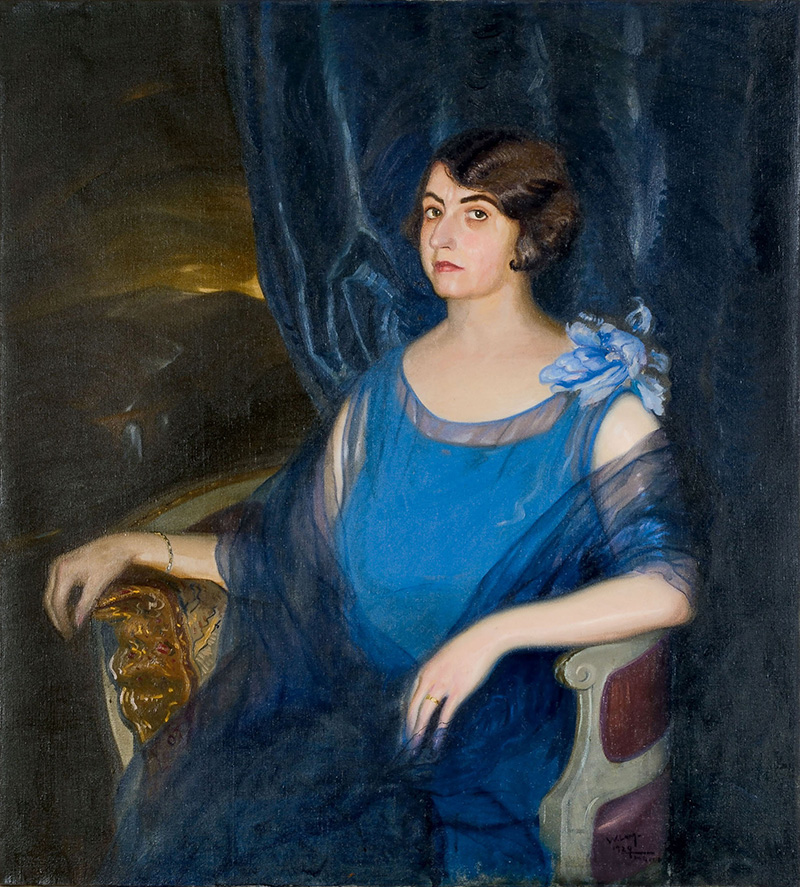
Wifredo Lam b. 1902, Sagua la Grande, Cuba; d. 1982, Paris, France Retrato de dama, 1929 Oil on canvas
This work was made when Wifredo Lam lived in Spain (1923–38), a formative period that began under the tutelage of Fernando Álvarez de Sotomayor, director of the Prado Museum, who introduced him to his workshop, where the Cuban made his first commissioned portraits under the academic influence of his mentor. Lam moved to Cuenca in 1925, where he continued to offer his services as a portraitist for the circle of friends and relatives of his friends Fernando Rodríguez Muñoz and Cayito Conversa Muñoz, who were related to each other and from wealthy families. Between 1925 and 1929, the artist moved between Madrid, Cuenca, and the nearby town of Villares del Saz, where he would spend the summers working in a studio-residence in the Conversa house. Numerous portraits were commissioned from him during this period, like this exquisite painting, attributed to a lady belonging to that family circle. The academic rigor stands out in this work, the assimilations of tradition evident in the careful drawing and the proficiency in pictorial techniques. The sobriety, both in the brushstrokes and in the colors, still does not reveal the universe of the artist’s later experimentation.
Lam has been considered the most internationally recognized Cuban artist. His work condenses the influence of the European avant-garde––fundamentally Surrealism and Cubism¬¬––African synthetic geometry, and Afro-Cuban and Caribbean legacy. He developed a particular iconography that revolutionizes the Euro-Western pictorial tradition and disarticulates the center-periphery hierarchies on which art history is inscribed.