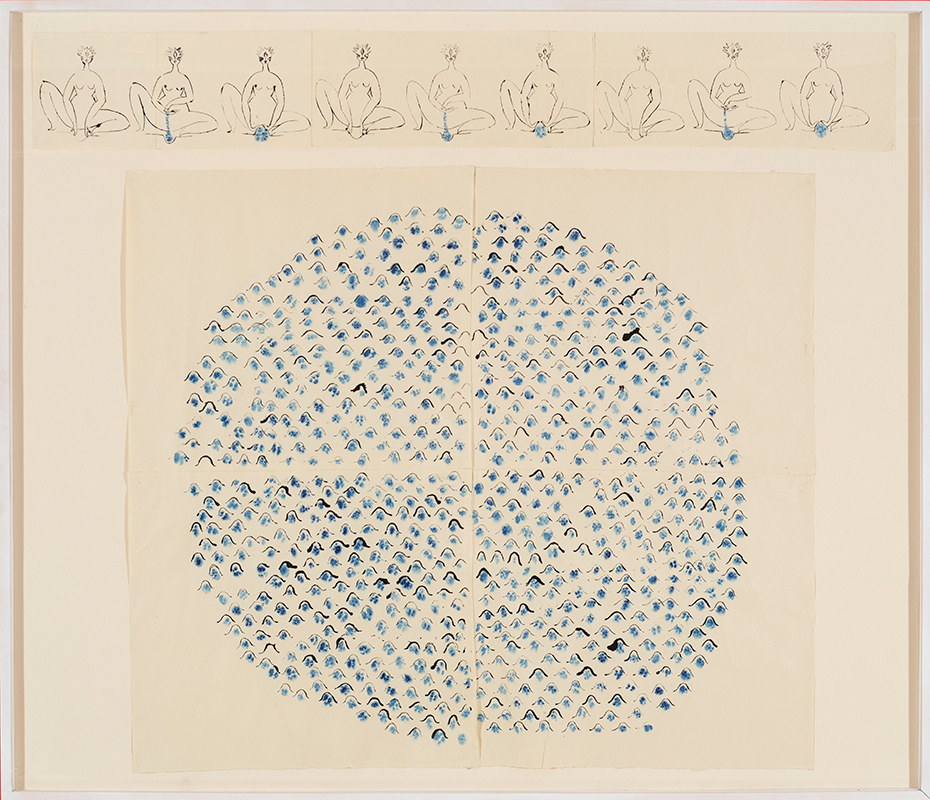
Anwulili Made Us in Her Likeness (Conception Sequence) and Our Conception, 2016 Ink and watercolor on Japanese kozo paper
In Anwulili Made Us in Her Likeness (Conception Sequence) and Our Conception (2016), Chioma Ebinama explores how histories of image-making shape cultural identity. Drawing inspiration from the mythologies of West Africa and pre-Columbian Americas, as well as the visual styles of American folk art and Japanese manga, she creates a transcultural bricolage that challenges fixed interpretations of self and origin. Working with ink and watercolor on delicate kozo paper, Ebinama embraces immediacy, play, and ephemerality as meditative forms of resistance.
Ebinama centers indigo as a pigment that is both divine and universal, creating a new myth around the plant that connects global craft traditions and emphasizes a shared sense of belonging among all beings on Earth. From this narrative emerges Anwulili, a deity of Ebinama’s own invention, which represents a transcultural blend of origin stories from various cosmologies. In this vision, birth is seen as a divine and sacrificial act. Throughout the sequence, Anwulili buries drops of her indigo-colored blood into the Earth like seeds. This repetitive gesture becomes a ritual act of devotion, aligned not with biological birth but with the idea of birth as conceiving ideas, meanings, and worlds.
In Our Conception, small mounds form a larger circle, reflecting artistic and religious traditions where circular forms symbolize cosmic unity and the cyclical nature of life. By reshaping and inventing origin stories, Ebinama positions mythmaking as a form of resistance and empowerment—one that is not fixed to a specific place or time and resists singular interpretations. In this space of multiplicity, the act of creation itself is affirmed as a source of value and power.
“Play is a form of resistance. You know a person isn’t free by how difficult it is for them to enter a state of play.”