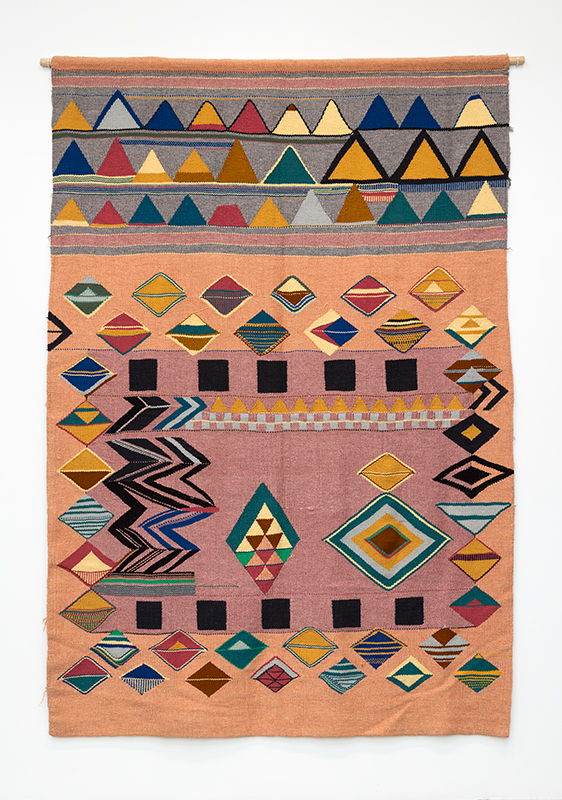
Weaving becomes a form of cartography in Lanceta’s practice, as her intricate textiles map cultural, geographic, and sociopolitical identities through the use of geometric symbolism. For Lanceta, geometry embodies life itself, and textiles serve as vessels for communicating global histories and systems of knowledge. Traditionally considered “women’s work” and long viewed as functional, Lanceta challenges the boundary between art and craft, embracing textiles as a means of defining and transmitting culture, while simultaneously offering an ecological reflection on the nature of art itself.
The upper portion of the work evokes a mountain range, with the intersecting lines below suggesting rivers or valleys that carve through the terrain. The patterned forms begin with a sense of order but soon fracture, echoing the balance between stability and flux found in natural systems. Geometry here is not decorative but generative, showcasing a visual language that mirrors the natural order, where repetition and variation yield an infinite number of possibilities. Jagged diagonal lines resembling lightning bolts cut through the composition, introducing a sense of sudden energy and transformation, while miniature landscapes seem to emerge within the diamond motifs, as if nature itself is unfolding from the geometric framework.