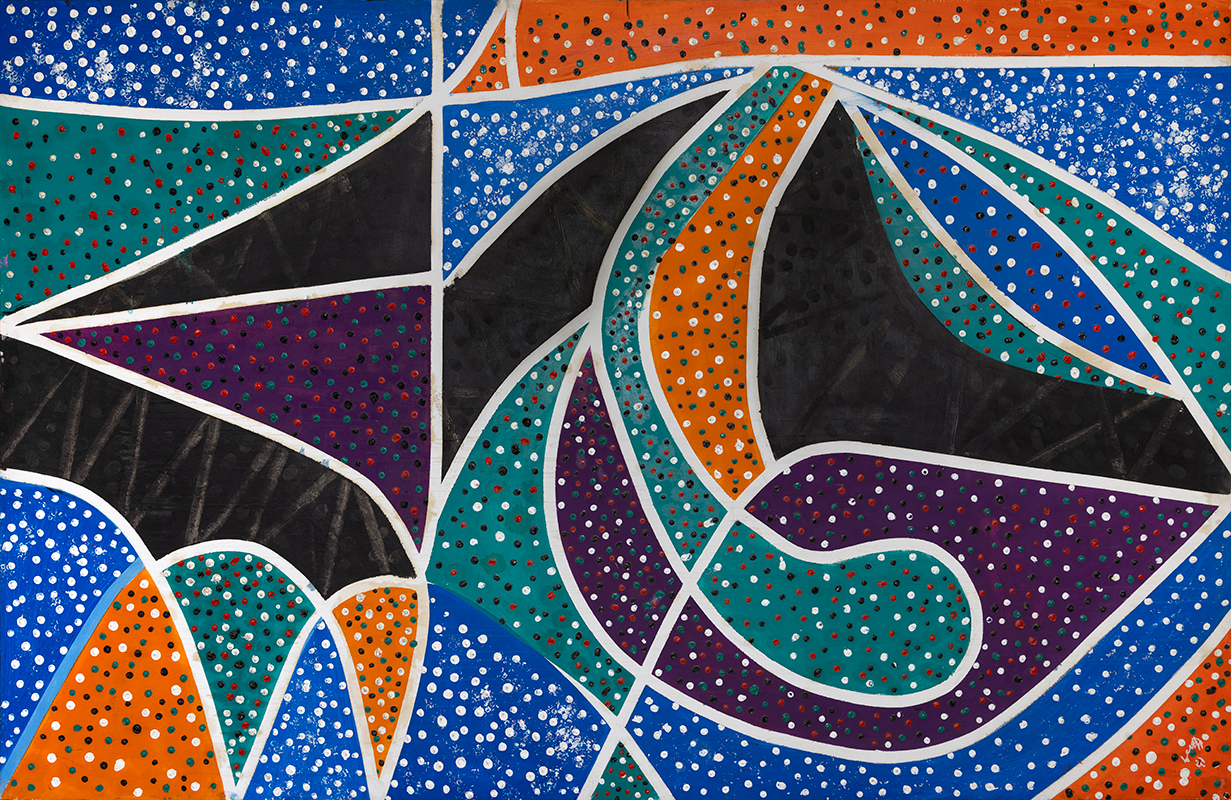
Invisible curva nello spazio (No invisible curves in space), 1991 Oil on panel
Bertina Lopes was a Mozambican painter, sculptor, and poet. Born in Maputo (then Lourenço Marques) during Portuguese colonial rule, Lopes became a key voice in modern African art and an early advocate for decolonial thought. Her practice fuses abstraction and figuration, combining bold color, gestural rhythm, and symbolic motifs that reflect both Mozambique’s cultural heritage and its turbulent path toward independence. Exiled to Rome in the early 1960s for her anti-colonial activism, she developed a visual language rooted in memory, resistance, and spiritual resilience. Lopes’s paintings often merge the cosmic and the earthly—depicting human forms, landscapes, and celestial geometries as interconnected forces—while addressing broader questions of identity, displacement, and liberation. Her artistic framework intertwines the political and the poetic, transforming the trauma of colonialism into a visionary assertion of cultural continuity and self-determination.
“Invisible curva nello spazio” (No Invisible Curves in Space) is a decolonial reflection on political landscapes. Multicolored dots fill the spaces within the colored segments between white lines, evoking the movement of people across Africa and the multitude of cultures and sociopolitical structures that coexist within a shared geography. The white lines function as boundaries or pathways that both divide and connect, while the black sections act as voids—moments of stillness amid an energetic chromatic rhythm. Within these dark areas, faint traces of lines and dots appear partially erased, serving as a poignant metaphor for the cultural erasures that followed Europe’s partition of Africa and its disregard for existing ethnic, linguistic, and ecological continuities. Lopes critiques the continent’s political landscape, exposing the artificial borders imposed through colonial cartographies that carved Africa, disregarding its natural and cultural rhythms. The painting’s curves and organic interplay of color resist the rigidity of imposed borders, asserting that, in reality, there are no invisible curves in space—that boundaries are neither natural nor inevitable. Through this oscillation between order and fluidity, Lopes envisions a more interconnected spatial logic rooted in movement, coexistence, and reclamation.