James Brown b. 1951, United States; d. 2020, Mexico
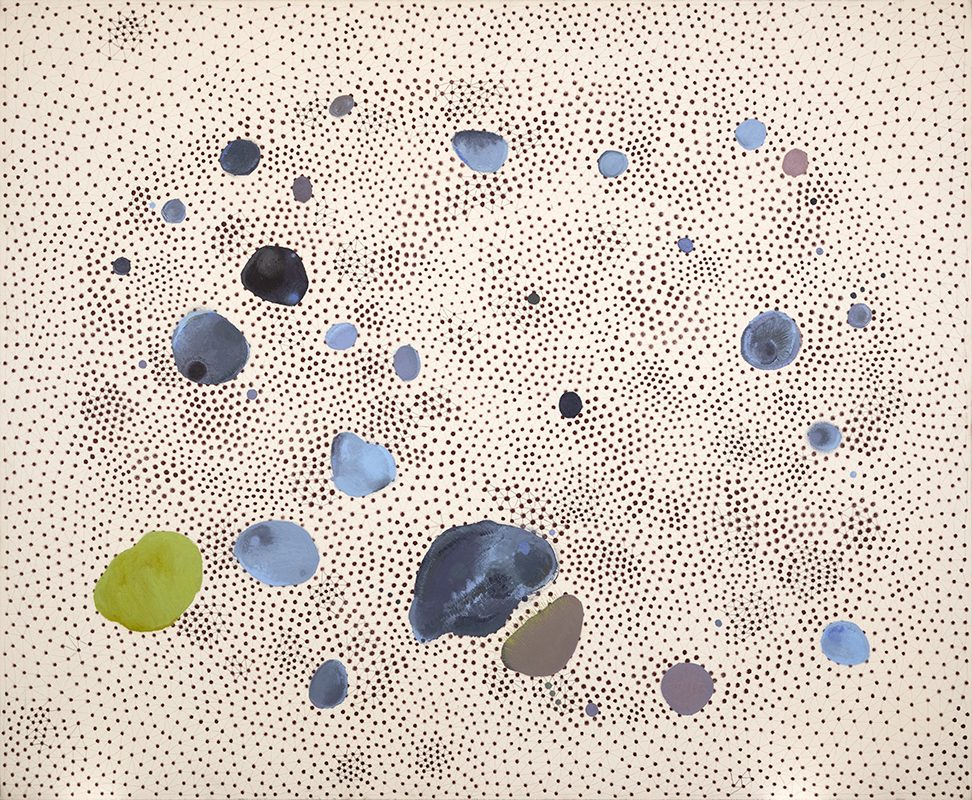
The visible planets III, 2007 Oil and graphite on canvas
James Brown’s The visible planets III (2007) forms part of his “Planets” series, inspired by Gustav Holst’s orchestral suite The Planets (1914–16) and architectural visions such as Buckminster Fuller’s geodesic domes. Brown reimagines cosmological diagrams by drawing upon medieval star charts and Indigenous cosmologies and interpreting them through the abstract language of modernism. His recurring circular motifs echo the cosmic symbolism found in artists such as Kandinsky and Klee, where geometry serves as a metaphor for spiritual and universal order.
In this atypical reading of the cosmos, Brown suspends biomorphic, planetary shapes within a constellation of brown and black dots on a vast, white surface—a clear inversion of the night sky’s colors. Fusing scientific, musical, and spiritual symbolism, he creates a cosmological diagram that is stripped of explicit legibility, instead inviting speculation. Rather than a literal star map or purely formal abstraction, he offers a mapping of the invisible. This map is a rendering of perception, memory, and metaphysical order, serving as a meditation on the unseen structures that establish order in both the universe and human consciousness.