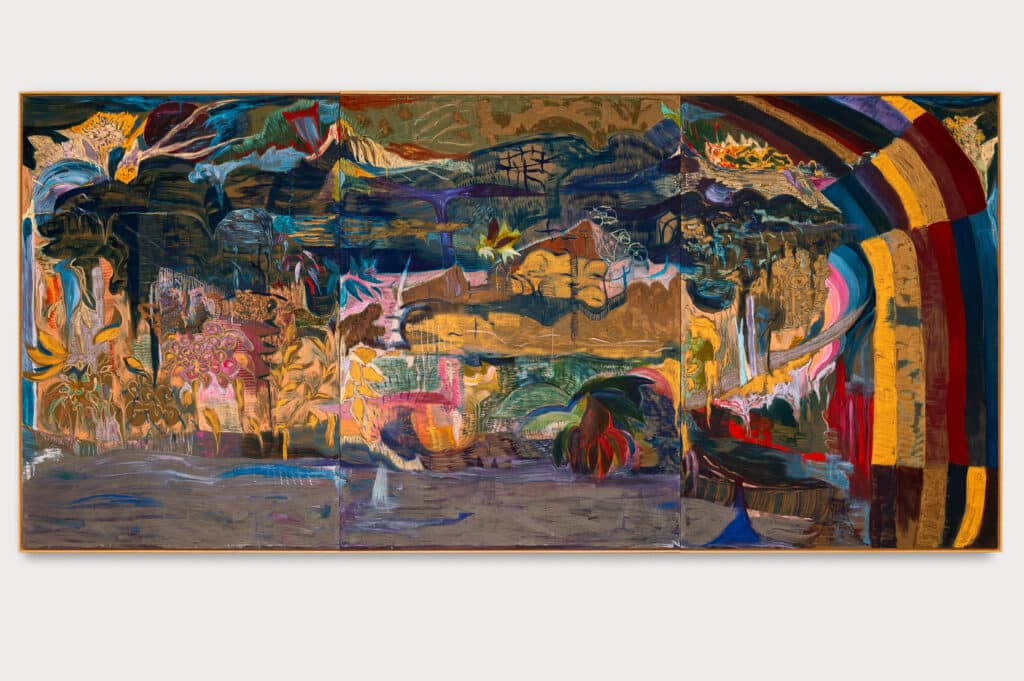
Améfrica: Diasporic Connections in the Collection of Jorge M. Pérez brings together artists from different parts of the American and African continents based on their resonances, shared references, related practices, mutual inspirations, continuities of research, and generational and ancestral transmissions that connect the shores of the Atlantic with a vivacity that is sometimes visible and at other times hidden.
The exhibition’s title is inspired by the concept developed by Lélia Gonzalez (1935–1994), an Afro-Brazilian intellectual whose work––articulating gender, race, and class in an innovative manner and in accessible language––opened paths toward a more critical view of the African foundations of the aesthetic and sociocultural formation of the Americas. Trained as a philosopher and active in the Black movement, Gonzalez was one of the principal formulators of Black feminism in Brazil, anticipating many of today’s central debates in cultural, racial, and gender studies. As philosopher Angela Davis remarked during a visit to Brazil in 2019, “Why do you need to look for a reference in the United States? I learn more from Lélia Gonzalez than you do from me.”
By renaming the Americas with an “f” that incorporates Africa, Gonzalez proposed more than a neologism: she named a relational, political, and aesthetic cartography that reorganizes the meanings of belonging, ancestry, and creation.
In Gonzalez’s words: “The marks that emphasize the Black presence in the cultural construction of the American continent led me to think about the need to develop a category that is not just limited to the case of Brazil and which, effecting a broader approach, takes into account the requirements of interdisciplinarity. Thus, I began to reflect on the category of Amefricanity.”
Améfrica does not take us back to Africa but transforms us on its basis. From music to cuisine, from spirituality to the visual arts, from philosophy to fashion, Africa has been––and continues to be––recreated in multiple forms and gestures in the Americas over the past five centuries. From performance and abstract sculpture to figurative painting and geometric explorations, Amefrican forms are manifested whenever Afrocentric cultural dynamics—“in their more or less conscious expressions”—are established.
In this sense, Améfrica critically questions older concepts of miscegenation and syncretism and decenters Europe as the primary reference point in the constitution of the New World: “The so-called Latin America . . . is actually much more Amerindian and Amefrican than anything else.” In dialogue with broader currents of Pan-Africanism, the concept also offers an expanded perspective of this movement, marking both affinities and differences between Africa and its diasporas, while taking the latter as a place of enunciation.
“In addition to its purely geographical character, the category of Americanity incorporates an entire historical process of intense cultural dynamics (adaptation, resistance, reinterpretation and creation of new forms) that is Afrocentric. . . . Its methodological value, in my view, lies in the fact that it allows for the possibility of reviving a specific unity, historically forged within different societies that were formed in a certain part of the world.”
Taking the concept with its methodological and poetic potentials, this exhibition weaves a dialogue among artists of different generations, geographies, and gestures who, through their networks of interconnection, register and recreate the African continent’s historical, formal, visual, symbolic, and intellectual influences on the American continent, both past and present, and vice versa.
The exhibition results from research into the works in Jorge M. Pérez’s collection; within the many possibilities of selection that the catalogue offers, highlighting the formal, thematic, and contextual relationships among these artists brings to light the relevance and contemporaneity of the concept of Amefricanity. It allows us to glimpse a vast territory in which national borders become less determinant than the cultural, political, economic, and symbolic connections that span and interconnect Afro-Atlantic spaces, contexts (physical, spiritual, and dreamlike), societies, and artists. The exhibition is organized in sections inspired by processes that Gonzalez identified as central to Amefricanity: Adaptation,Resistance, Reinterpretation, and Creation of New Forms, in additionto a section dedicated to portraits made by Amefricans.








Sorry, the comment form is closed at this time.